
Understanding Development Budget Execution in Pakistan’s Fiscal Framework
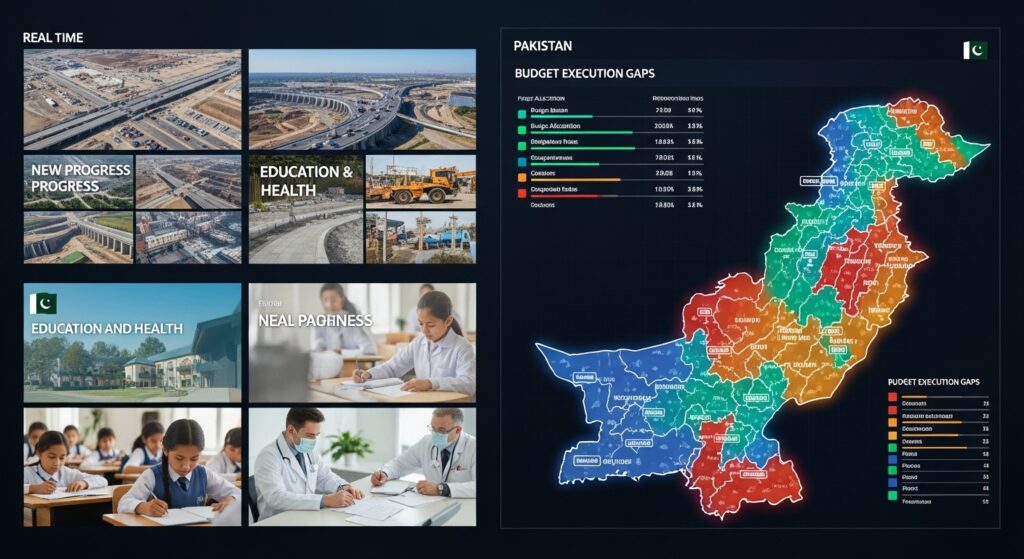
Development budget execution—the extent to which provinces utilize their Annual Development Plan (ADP) allocations—is a key indicator of fiscal discipline and governance effectiveness. Despite significant allocations under the Public Sector Development Program (PSDP) and provincial ADPs, Pakistan continues to face persistent execution gaps, particularly in the social and infrastructure sectors.
In the fiscal architecture established after the 18th Amendment, provinces command over 50% of public expenditure, yet execution rates remain modest. By mid-FY 2024–25, national average development budget utilization hovered around 55%, underscoring structural challenges in project planning and release management.
Provincial Comparison: Trends and Gaps in FY 2024–25 Execution Rates
A review of provincial finance and planning reports shows a mixed picture. Punjab and KP recorded higher execution rates (around 60–65%) compared to Sindh and Balochistan (below 50%) in the first half of FY 2024–25. These numbers, however, mask sectoral disparities—education, health, and local development programs show higher absorption capacity, while infrastructure and mega projects remain underutilized due to procurement delays and weak contractor capacity.
Moreover, the traditional “year-end spending rush” continues to distort fiscal management. Provinces often release 40–50% of their ADP allocations in the last quarter, undermining project quality and transparency.
Spotlight Province: Punjab’s Development Budget Performance
Punjab, with Pakistan’s largest ADP of around Rs700 billion for FY 2024–25, presents a revealing case. As of the third quarter, execution stood near 62%, showing improvement over the previous fiscal year but still below potential.
Key trends include:
- Sectoral imbalance: Health and education projects achieved around 70% utilization, while infrastructure and agriculture lagged below 50%.
- Release delays: The Finance Department’s staggered release strategy—tied to revenue flows—slowed implementation of multi-year schemes.
- Administrative rigidities: Limited delegation of financial powers to line departments hampers timely project execution.
- Procurement and coordination issues: Line departments report tendering delays and weak alignment between Planning & Development (P&D) Department and implementing agencies.
Punjab’s experience underscores a broader challenge: capital spending efficiency remains constrained by bureaucratic processes and fiscal uncertainty.
Key Factors Behind Low or High Execution Performance
Several cross-cutting factors influence provincial budget execution:
- Revenue volatility due to uncertain federal transfers under the NFC Award.
- Weak project readiness — many ADP projects lack approved PC-I documents at the start of the year.
- Centralized controls in Finance Departments, delaying fund releases to implementing units.
- Limited M&E capacity, leading to poor feedback loops for corrective action.
- Political transitions that often shift priorities mid-cycle, stalling project momentum.
Fiscal Governance, Procurement, and Capacity Constraints
The fiscal governance framework across provinces remains compliance-focused rather than performance-driven. While the PFM Act (2019) and Treasury Single Account reforms improved fiscal control, execution flexibility remains low.
Procurement systems, governed by provincial PPRA rules, often suffer from cumbersome approval timelines. The absence of digitalized project tracking tools further limits transparency. Strengthening capacity within P&D departments and local governments is crucial to bridging this gap.
Policy Lessons from Inter-Provincial and International Experiences
India and Bangladesh provide relevant comparisons. Both have introduced medium-term expenditure frameworks and performance-linked budgeting, ensuring that funds flow to projects based on measurable outputs. Punjab’s experiment with a Program-Based Budgeting (PBB) pilot in the education sector is a step in this direction and should be scaled up.
Moreover, greater coordination between provincial and district tiers—as seen in Bangladesh’s Local Government Division—is critical to avoid duplication and improve service delivery outcomes.
Actionable Recommendations
- Adopt multi-year project readiness filters to ensure ADP entries are fully appraised before inclusion.
- Digitize fund release and expenditure tracking for real-time monitoring.
- Strengthen M&E units within provincial P&D departments.
- Introduce quarterly performance reviews linked to fiscal disbursements.
- Institutionalize program-based budgeting across all major departments.
Conclusion
As provinces finalize their FY 2025–26 budget strategies, improving development budget execution must remain a top priority. Punjab’s experience offers valuable insights into how planning, capacity, and fiscal coordination affect project delivery. Strengthening institutional mechanisms and adopting evidence-based budgeting can help ensure that public investment translates into tangible development outcomes rather than unspent allocations.
This article was published on publicfinance.pk.
FAQs
Q1: What does “development budget execution” mean?
It refers to the percentage of allocated development funds that are actually spent during the fiscal year on approved projects and programs.
Q2: Why do provinces struggle to execute their full development budgets?
Common issues include delayed fund releases, weak project planning, procurement bottlenecks, and shifting political priorities.
Q3: How can Pakistan improve provincial budget utilization?
By adopting multi-year planning, digital monitoring tools, and performance-linked budget releases to ensure funds are efficiently used.
